
Key Takeaways
● The new law makes it harder for non-profits to get foreign money.
● Chapter IIIA has new rules for how groups handle their money.
● Automatic cessation is a big risk for groups that don't file on time.
● The rules now make it riskier to run a group.
● Checking your legal status is now a must to keep going.
Quick Summary of the FCRA Amendment Bill 2026
The FCRA Amendment Bill 2026 changes how foreign-funded groups handle their money and follow rules. It makes the rules tighter for groups getting money from abroad. Now, these groups face more checks that could affect their future.
The biggest risks with the FCRA Amendment Bill are the sudden loss of assets and more work for board members in audits. These changes make a high-risk situation where small mistakes can cause big legal problems. The following groups are most at risk:
● Educational Institutions: Schools and research places that get grants from abroad.
● Healthcare Providers: Health groups and clinics that get money from other countries for health work.
● Human Rights Organizations: Groups often checked by governments about their funding sources.
As the 2026 law season goes on, groups need to take steps to protect themselves. They must change how they manage money and be open about it.
To deal with these new legal dangers, we suggest the following actionable next steps:
● Do a quick check of all money from abroad to make sure it follows the new rules.
● Look at insurance for board members and update how they work to meet new personal responsibility rules.
● Create a special team to keep up with new rules and keep detailed records of all money dealings.
What’s New in the FCRA 2026 Amendments
Wondering about the new FCRA amendment? The 2026 updates bring big changes for non-profits. The FCRA Amendment Bill 2026 changes how non-profits work in India. It focuses on more oversight, controlling assets, and clearer accountability.
The FCRA 2026 amendments create a Designated Authority FCRA. This group will watch over compliance and handle asset control. The goal is to make enforcement easier, but it poses big challenges for NGOs.
https://www.youtube.com/watch?v=c-lu7-ExbrE
Chapter IIIA in the new law deals with asset transfers. Sections 16A to 16D outline how the government handles assets during investigations. These FCRA changes 2026 India let the state act faster when there's a suspected violation.
"The shift toward administrative control over civil society assets represents a profound change in the regulatory philosophy of the FCRA Amendment Bill."
The FCRA Amendment Bill also broadens who is considered a "key functionary." This means board members and top staff face more personal responsibility for following the rules. Plus, the 2026 updates make it easier to charge leaders with crimes.
Oversight Body | Ministry of Home Affairs | Designated Authority FCRA |
Asset Control | Limited Seizure | Full Asset Vesting |
Liability | Organizational | Expanded Key Functionary |
Legal Threshold | High | Lowered for Imprisonment |
The FCRA 2026 amendments show a trend of more scrutiny. Non-profits will face more audits and stricter reporting. Keeping up with the FCRA Amendment Bill 2026 is now crucial for social sector groups.
Chapter IIIA Explained: Provisional vs. Permanent Asset Vesting
Many organizations wonder if Chapter IIIA of FCRA will protect or harm their future. This new law lets the state take over assets bought with foreign money. It changes how non-profits manage their property in India.
This law focuses on the difference between temporary control and permanent ownership. The government wants to make sure assets funded by foreign grants stay true to their purpose. But this makes it hard for boards to plan for the long term.
How Provisional Vesting Works and Trigger Events
Provisional asset vesting under FCRA happens when a rule is broken, like a license being suspended. The government takes control of assets to stop them from being sold or changed. This is to keep the property safe while the issue is being sorted out.
Imagine a community hospital built with foreign money. If its FCRA license is suspended, the government might take control. The hospital can still run, but it can't sell or change the building without state permission.
"The transition from regulatory oversight to asset control represents a profound expansion of state power over the civil society sector, potentially challenging the fundamental right to property."
When Provisional Becomes Permanent: Timelines and Outcomes
Can the government take NGO assets under FCRA 2026? It depends on the review's outcome. If an organization can't fix the problems in time, the government might take permanent control. This means the state owns the asset or moves it to another group.
The table below shows the main differences between provisional and permanent control:
Legal Status | Temporary Custody | Final Transfer |
Management Rights | Restricted/Supervised | Terminated |
Primary Goal | Asset Preservation | Public Reallocation |
Duration | Pending Investigation | Indefinite |
Organizations need to watch their compliance deadlines closely. They should report everything clearly and manage funds well to avoid losing control.
Mixed Funding: The Practical Nightmare for NGOs
Mixed funding is a big challenge for charities in India. When they mix local and foreign money for projects, they face a lot of financial checks. This makes many groups change how they handle money to stay out of trouble.
How will FCRA 2026 affect NGOs in India? The main worry is showing where each dollar went. For places like hospitals or schools, it's hard to say which money bought what. Mixing funds makes it tough to prove something was bought with only local money.
The impact on NGOs in India is huge. They have to prove everything clearly or else they might lose control over their assets. If they can't show where the money came from, the government might take over what they bought.
To keep safe, NGOs need to be very careful with their money. Having separate accounts for foreign and local funds is now a must. Here are some steps to help avoid problems:
● Use dedicated project-specific bank accounts to keep funds separate.
● Keep chronological records of all money transactions for assets.
● Make sure all bills and payments show where the money came from.
● Do quarterly internal audits to check that money and assets match up.
By following these strict rules, groups can deal with the new laws better. Being proactive is the best way to avoid trouble with the new rules.
Automatic Cessation and Bureaucratic Weaponization
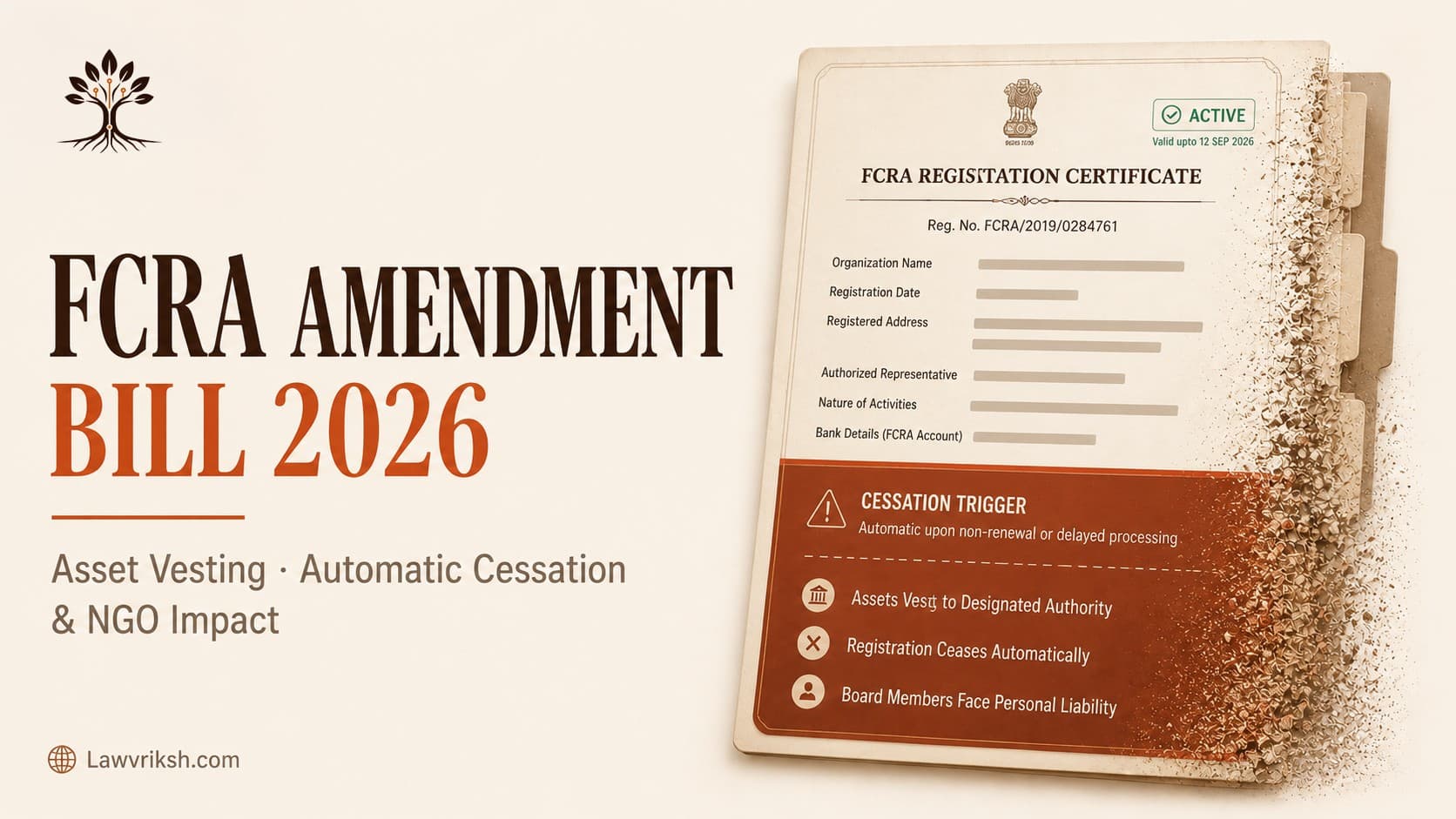
Knowing what is an automatic cessation under FCRA? It is key for any group going through the renewal process. This rule, under Section 14B, stops an entity's registration if they don't renew on time.
The Designated Authority FCRA now has a big say in whether non-profits can operate. If they take too long, the law stops their rights, not just delays them.
This means that doing nothing can be a way to enforce rules. The Designated Authority FCRA can make an organization non-compliant by just not acting fast enough.
This highlights a broader legal principle that appears across regulatory systems: procedural mechanisms often shape outcomes as much as substantive decisions.
A similar issue emerged in criminal procedure when the Allahabad High Court examined whether police authorities could alter the language used in an FIR. While the context was entirely different, the underlying question was similar—how much discretion should administrative authorities possess when handling official legal records. Readers interested in the relationship between procedure and state power may also find useful insights in our analysis of the Allahabad High Court's ruling on FIR drafting practices.
The table below shows the big difference between what's supposed to happen and what really does. This gap is where the automatic cessation of FCRA is most risky for NGOs.
Application Submission | 6 Months Prior | Variable | Low |
Initial Verification | 30 Days | 90+ Days | Moderate |
Final Approval/Renewal | 90 Days | Indefinite | Critical |
Cessation Trigger | N/A | Post-Expiry | Severe |
Groups need to understand that not hearing back from the regulator is not okay. They must keep an eye on their application status to stay alive in today's rules.
Expanded Liability and Compliance for Board Members
Understanding the FCRA changes 2026 India is key for board governance and personal protection. The new rules widen who is seen as a "key functionary." This means more people are watched closely by authorities.
Now, board members must show they did their job well and honestly. Keeping detailed records is crucial.
To handle these risks, strong internal controls are needed. Start by using a governance checklist. This helps ensure you follow all FCRA changes 2026 India rules. Here are some key practices for your board:
● Quarterly Compliance Audits: Check all foreign contributions and spending regularly.
● Documented Oversight: Keep detailed meeting minutes that show you followed rules.
● Due-Diligence Protocols: Check all partners and sub-grantees to avoid misuse of funds.
● Conflict of Interest Disclosures: Ask board members to declare any conflicts yearly.
Board members should also get help to protect themselves. Getting Directors and Officers (D&O) insurance is a good idea. It helps cover legal costs. Also, having a lawyer ready can help with FCRA changes 2026 India issues.
The main goal is to make everyone accountable. Focus on being open and keeping detailed records. This way, board members can protect their reputation and the organization. Staying ahead of these changes is the best way to keep things stable.
Constitutional Challenges and Legal Grounds for Litigation
Challenging the FCRA Amendment Bill 2026 means looking closely at basic rights and legal protections. The Supreme Court of India set a broad rule for state control in Noel Harper v. Union of India (2022). But the new rules on asset control and automatic end push the limits of state power. Groups are now using specific constitutional parts to create a strong legal plan for lawsuits.
The power of the state to regulate foreign contributions must always be balanced against the fundamental rights of citizens to organize and manage their own affairs without undue interference.
Article 300A (Property)
The new rules on permanent asset control raise big concerns under Article 300A. This article says no one can lose their property without the law. Experts say the automatic taking of NGO assets by the state could be against the law.
Article 19(1)(C) (Association)
The freedom to form groups is key to a healthy democracy under Article 19(1)(c). The strict rules could stop people from joining groups for good causes. Lawsuits will likely ask if these rules are fair and needed.
Article 14 (Arbitrariness)
Article 14 ensures everyone is treated equally and stops unfair state actions. The 2026 changes give a lot of power to officials, which could unfairly target some groups. If the rules are seen as unfair, they could be ruled against as unfair treatment.
Article 300A | Unlawful deprivation of property | High risk to asset ownership |
Article 19(1)(c) | Infringement on association rights | Chilling effect on civil society |
Article 14 | Manifestly arbitrary state action | Increased risk of selective targeting |
Conclusion
The rules for non-profits in India are changing. They will have to watch out for strict checks and possible loss of assets. It's crucial for them to do quick internal checks to protect their money.
Being proactive is key to dealing with these new rules. Board members need to check their work against the new standards. Has the FCRA Amendment Bill 2026 been passed? Keep an eye on the official government website for updates.
It's important for NGO leaders to stay up-to-date. Getting legal advice can help you understand how these changes affect your group. Has the FCRA Amendment Bill 2026 been passed? Look at government sources for the latest news to help plan your future.
FAQ
Has the FCRA Amendment Bill 2026 been passed?
The FCRA Amendment Bill 2026 is still being reviewed by the Parliament of India. For the latest updates, check the official PRS Legislative Research website or the Gazette of India.
What is the new amendment of FCRA?
The new FCRA amendment brings strict rules. It includes Chapter IIIA FCRA, which deals with asset vesting. It also introduces a Designated Authority FCRA and changes the definition of "key functionaries."
Another key change is the automatic end of registration certificates.
What does Chapter IIIA of FCRA do?
Chapter IIIA FCRA lets the government take control of an organization's assets. It explains how assets are held by a Designated Authority after registration cancellation or expiration. It also talks about when this becomes permanent.
How will FCRA 2026 affect NGOs in India?
NGOs in India will face big challenges. They risk losing their assets and will have to deal with more rules. This could lead to job losses and less funding for important projects like hospitals and schools.
Can the government seize NGO assets under FCRA 2026?
Yes, the government can take NGO assets under FCRA 2026. This is true if an organization's registration is cancelled or expires. It's a big risk for NGOs with both foreign and domestic funding.
What is automatic cessation under FCRA?
Automatic cessation under FCRA means a registration certificate ends if it's not renewed or there are delays. Once it ends, the organization can't manage assets bought with foreign funds. These assets might go to the Designated Authority FCRA right away.
What are the implications for board members under the FCRA changes 2026 India?
The FCRA changes of 2026 make more board members and executives liable. They now have to prove they followed the rules during audits or investigations. This is a big change for them.
What is the "mixed funding" problem mentioned in the bill?
The "mixed funding" problem happens when NGOs use both domestic and foreign donations for projects. If the registration is lost, the government might take the asset. This is because NGOs struggle to show where the money came from.
What legal recourse do NGOs have against asset vesting?
NGOs can fight these rules in the Supreme Court of India or the High Courts. They can use constitutional arguments. They might argue against the rules based on the right to property, freedom of association, and fairness.