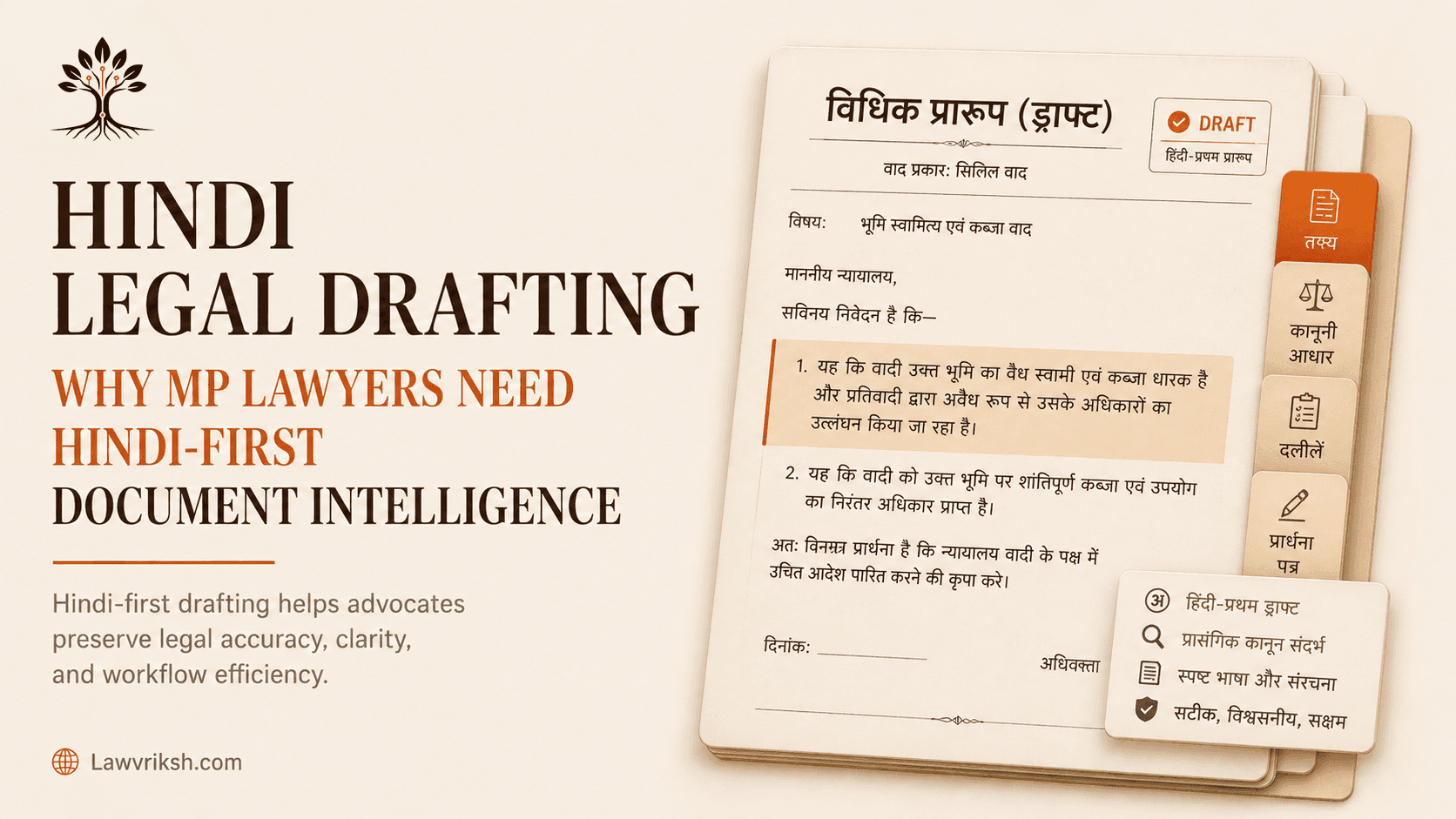
What is Hindi legal drafting?
If you are a young lawyer practising in Madhya Pradesh, you already know that Hindi legal drafting is more than translating English into Hindi. Effective legal drafting in Hindi requires precision, clarity, procedural understanding, and familiarity with the language commonly used across Madhya Pradesh district courts, revenue courts, and government offices.
Many lawyers assume drafting is primarily a translation exercise. In practice, successful Hindi legal drafting involves structuring facts, arguments, and reliefs in a way that aligns with judicial expectations while remaining accessible to clients.
Defining the scope beyond simple translation
In a Hindi-medium legal environment, terminology must be legally accurate and contextually appropriate. Direct translation frequently misses procedural nuances, statutory meaning, or local drafting conventions.
The objective is not merely to change language. The objective is to create legally sound documents that preserve meaning, support arguments, and fit the expectations of the court.
Common documents in the Madhya Pradesh legal landscape
• Bail applications and affidavits
• Written statements and plaints
• Notices and formal correspondence
• Revenue court petitions
• Applications and procedural filings commonly used across Madhya Pradesh district courts and quasi-judicial forums
The role of Hindi in district courts and government filings
Hindi remains the primary working language for many district courts and government filings across Madhya Pradesh. Clear and precise drafting improves comprehension for court staff, litigants, and judicial officers while reducing procedural confusion.
The importance of legal accessibility has also been recognised nationally through the Supreme Court’s SUVAS initiative, which focuses on improving access to legal material across languages. Translation improves accessibility, but effective drafting still requires legal context and professional judgment.
Why is Hindi important for MP lawyers in drafting?
For advocates practising in Madhya Pradesh, Hindi is often the language in which legal problems are first explained and legal remedies are ultimately understood.
Navigating local practice norms
Many district courts operate primarily in Hindi. Drafting directly in Hindi helps ensure that submissions are understood clearly and align with local practice expectations.
Building client trust
Many clients are unfamiliar with English legal terminology. Hindi drafting helps bridge the gap between legal procedure and client understanding, improving trust and communication.
The pitfalls of relying on English-to-Hindi translation
Automated translation and literal translation often fail to capture legal intent. Context-aware drafting reduces the risk of ambiguity and improves document quality.
What are the common problems in Hindi legal drafting?
Many lawyers search for templates, PDFs, or ready-made formats hoping to save time. While these resources can be useful references, they often fail to address the specific facts and procedural requirements of individual matters.
Why is it risky to depend only on ready-made drafts?
Generic drafting bundles are designed for broad use. They rarely account for case-specific facts, local procedural realities, or strategic considerations.
This problem is similar to the challenge discussed in LawVriksh's article “Your Draft Is Not The Problem. The Missing Reasoning Is: How Juniors Can Send Better Drafts for Senior Review.” A document can appear complete while the reasoning behind it remains missing.
What mistakes occur during direct translation?
Legal Hindi has its own terminology and drafting conventions. Direct translation frequently introduces inaccuracies, awkward phrasing, or unintended meaning.
Why do templates sometimes slow work down?
Lawyers often spend significant time editing, correcting, and restructuring templates. In many cases, adapting an unsuitable draft takes longer than creating a tailored one.
Why do traditional Hindi drafting workflows create errors?
Many drafting mistakes begin in the workflow itself rather than in the final document.
A common process looks like this:
English Draft → Translation → Terminology Correction → Formatting Adjustment → Final Review
Each additional layer creates opportunities for meaning loss, inconsistency, or procedural error.
A Hindi-first drafting workflow reduces these friction points by treating Hindi as the primary drafting language rather than as a translated output.
What is Hindi-first document intelligence?
Document intelligence is more than a template library. It is an approach that uses technology to understand context, organise information, and support drafting decisions.
What is the difference between document intelligence and templates?
Templates remain static regardless of facts. Document intelligence adapts to context, highlights missing information, and supports consistency across documents.
This distinction is important because document intelligence is not designed to replace advocates. As discussed in the LawVriksh article “Will AI Replace Lawyers? It Can't Remember the Case Long Enough to Try,” legal work depends heavily on context, chronology, and judgment.
How does Hindi-first document intelligence help lawyers?
• Improves consistency
• Reduces repetitive drafting work
• Supports terminology accuracy
• Helps identify missing information
• Frees advocates to focus on strategy and analysis
Can AI replace Hindi legal drafting?
No.
AI can assist with first drafts, summaries, clause suggestions, and terminology support. However, legal drafting still requires professional judgment, factual evaluation, procedural awareness, client-specific context, and accountability.
Technology can support lawyers. It cannot independently assume responsibility for legal outcomes.
For advocates practising in Madhya Pradesh courts, AI should be viewed as a drafting assistant rather than a replacement for legal expertise.
How to effectively use tools for Hindi legal drafting?
What tasks can AI help with?
• First-draft preparation
• Document summarisation
• Clause suggestions
• Research organisation
• Draft review assistance
How do you verify AI-generated drafts?
Lawyer-led review remains essential. Every document should be checked for:
• Correct cause titles
• Accurate statutory references
• Appropriate reliefs
• Procedural compliance
What about confidentiality and bias?
Sensitive client information should never be shared carelessly. Lawyers should anonymise data whenever possible and independently verify all outputs.
How can young advocates learn Hindi legal drafting systematically?
Learning Hindi legal drafting requires deliberate practice.
How to prepare notes on Hindi legal drafting?
Create a personal clause bank. Maintain organised notes containing commonly used clauses, procedural language, and statutory references.
Hindi legal drafting example kahan milega?
The best sources are:
• Official court forms
• Verified precedents
• Madhya Pradesh High Court materials
• Trusted legal publications
Which tools can help with Hindi legal drafting?
Tools such as ChatGPT can assist with drafting support, summaries, and document organisation. However, all outputs should be reviewed by the advocate before use.
Building a long-term drafting system
Method | Reliability | Long-Term Value
Generic Templates | Low | Poor
Personal Clause Bank | High | Excellent
Official Court Precedents | Very High | Excellent
By building a trusted drafting repository, advocates become less dependent on generic templates and more capable of producing consistent, high-quality legal work.
Conclusion
The future of Hindi legal drafting in Madhya Pradesh is not about choosing between traditional practice and technology. It is about combining legal expertise with better workflows.
Advocates who invest in drafting skills, procedural understanding, and Hindi-first document systems can reduce repetitive work while improving accuracy and client service.
Technology can accelerate drafting. It cannot replace legal judgment.
The strongest legal practices will combine professional expertise, trusted precedents, structured workflows, and carefully supervised technology to produce better legal documents and better outcomes for clients.
FAQ
What is Hindi legal drafting?
Hindi legal drafting is the process of preparing legal documents directly in Hindi while preserving legal accuracy, procedural compliance, and court-specific drafting conventions.
Why is Hindi legal drafting important in Madhya Pradesh?
Hindi remains the primary working language across many district courts, revenue courts, and government offices in Madhya Pradesh. Effective Hindi drafting improves communication, clarity, and client understanding.
Hindi legal drafting notes kaise banaye?
Create a personal clause bank, maintain a glossary of legal terminology, and collect verified precedents from actual court filings.
Hindi legal drafting example kahan milega?
The most reliable examples come from official court formats, verified precedents, government forms, and documents reviewed by experienced advocates.
Hindi legal drafting ke liye kaun si AI tools help kar sakti hain?
AI tools such as ChatGPT can assist with drafting support, document summaries, and clause suggestions. However, all outputs should be reviewed by a lawyer before filing.
Can AI replace Hindi legal drafting?
No. AI can assist with drafting tasks but cannot replace legal judgment, procedural strategy, factual evaluation, or professional accountability.
What is Hindi-first document intelligence?
Hindi-first document intelligence refers to systems that help lawyers draft, organise, review, and manage legal documents in Hindi while preserving legal context and workflow continuity.