

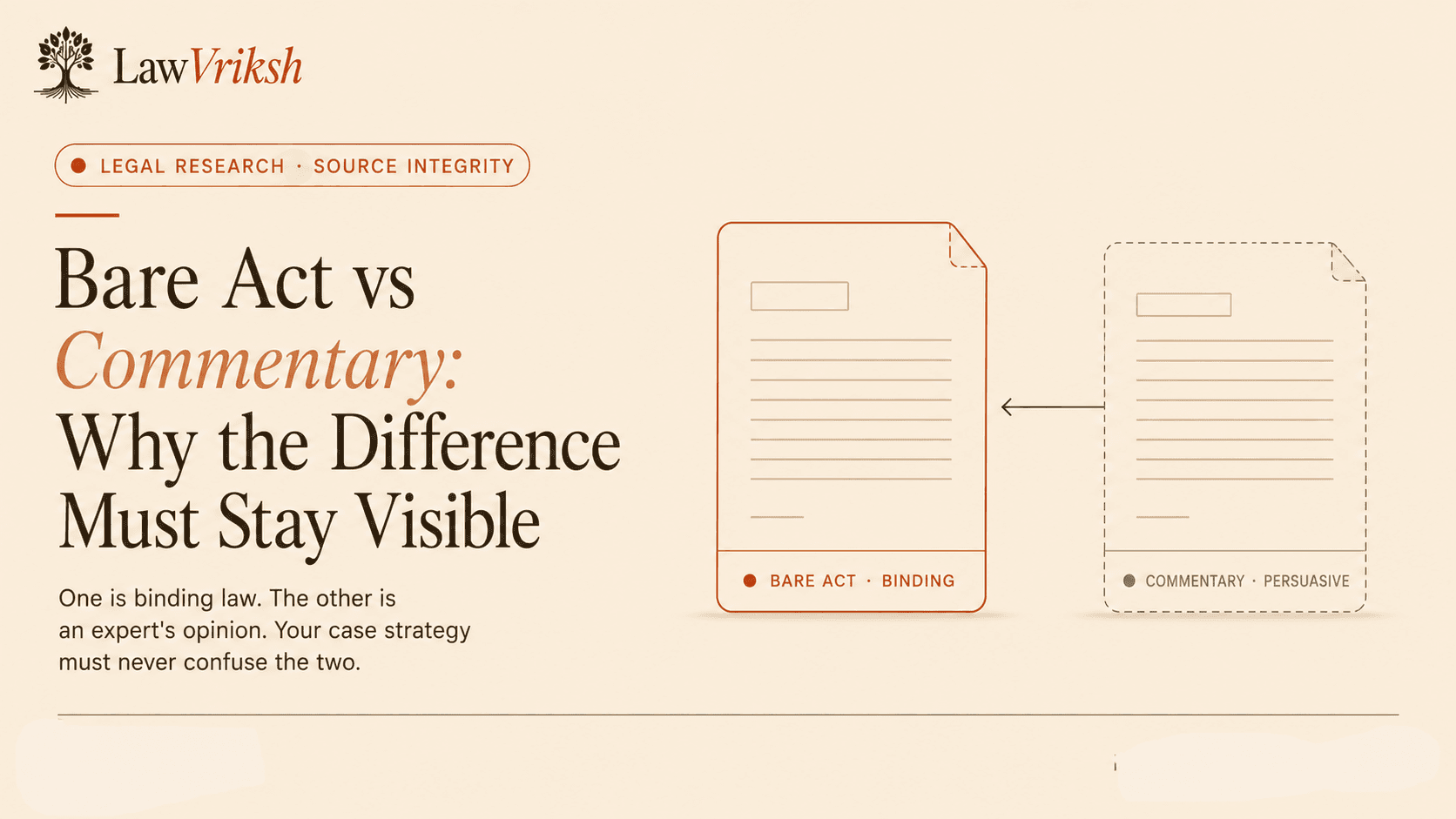
It's crucial to keep these two clear for any lawyer aiming for accuracy. By separating the bare act from expert views, your arguments stay true to the law. This clear start helps avoid mistakes where opinions are seen as law, giving you control over your legal plan.
Key Takeaways
The primary source of law is the official, unannotated legislative text.
Commentaries offer valuable insights but do not replace the original statute.
Distinguishing between these two sources is vital for accurate legal research.
Clear separation prevents the error of treating opinions as binding authority.
Maintaining this boundary strengthens your chamber workflow and case preparation.
What Is a Bare Act?
A bare act is the raw, official text of a law as passed by the legislature. It has no
external interpretations. This means it's the true, unaltered version of a statute.
For lawyers, this document is crucial. It's the bedrock of legal
practice. It gives the rules that govern our legal world without secondary
opinions.
Learning the bare act is key. It helps you understand the law's
intent clearly. Reading the original text is the first step for any lawyer. It
keeps your arguments based on the law itself, not someone else's view.
Here are some key points about this document:
Feature | Description | Significance |
Content | Official | Primary source |
Annotations | None | Prevents biased |
Authority | Binding | Highest level of |
Usage | Foundational | Essential for |
What Is a Legal Commentary?
A legal
commentary is more than just the law. It gives you the expert's view on the
law. It helps you understand the law's purpose and how it has changed over
time.
Remember, these resources are not the law itself. They are secondary
sources. Always check the law itself or court decisions to confirm what you
read.
"The law is not a static set of rules, but a living
framework that requires careful interpretation to meet the needs of
justice."
Using a legal commentary means you're getting someone else's
opinion. This opinion is very useful for understanding the law's details. But,
it's not the law itself.
It's key to know the difference between the law and a legal
commentary. This way, your arguments are based on the law, not just someone's
opinion. This makes your legal research stronger and more reliable.
Bare Act vs Commentary:
Understanding the Difference
Knowing the difference between a bare act and a legal commentary is
key to a strong case. As a lawyer, choosing the right source is crucial for
your arguments in court. It's important to treat these sources differently to
keep your research and drafting accurate.
Binding Law vs Expert
Interpretation
The bare act is the law as passed by the government. It's the main
source of authority. On the other hand, a legal commentary is an expert's view
on how to apply the law. While scholars offer valuable insights, their opinions
are not legally binding.
Remember, examples in a statute are meant to help clarify, but
they're not law. If an example goes against the law's text, the statutory text
always wins. Always choose the legislative intent over scholarly opinions when
they disagree.
When to Rely on a Bare Act
Use the bare act to establish your legal position. It's the base of
your pleadings and arguments. By sticking to the statute, your arguments stay
strong and authoritative.
Using the statute directly helps avoid outdated or biased views.
Start your submissions with the specific law section. This keeps your work
clear and defendable in critical hearings.
When Commentaries Add Value
A legal commentary is useful for understanding complex law. They
offer historical context, legislative intent, and court interpretations. Use
them to enhance your understanding, but never replace the statute.
The table below shows the main differences to remember in your daily
work:
Feature | Bare Act | Legal Commentary |
Authority | Binding Law | Persuasive |
Purpose | Establishes | Explains |
Reliability | Absolute | Subject to |
Usage | Primary Source | Secondary |
Risks of Confusing Commentary
with the Law
Confusing a scholarly opinion with a law can ruin a case. Treating
secondary analysis as primary authority weakens your argument. It's crucial to
keep these two separate for accurate legal work.
Incorrect Legal Research and
Drafting
Legal research means finding the exact statute text first. Using
legal commentary instead of the original text can lead to mistakes. Always
check the original law first.
Drafting mistakes often come from using a commentator's summary as
law. This can make your documents inaccurate and hard to defend.
Weak Arguments in Court Hearings
A court hearing tests your preparation and source quality. If you
present an interpretation as law, a judge might spot the mistake. Judges are
strict about law accuracy.
Your credibility in court comes from citing primary sources
confidently. Using legal commentary instead shows a lack of preparation. Stick
to the statute itself, using secondary sources to support your interpretation.
Read more about Court
Hearing Preparation: Why a Hearing Brief Should Be Generated Only from Verified
Facts, Not Raw Documents.
Misleading Citations and
Unsupported Claims
Misleading citations happen when you confuse primary and secondary
sources. Citing a legal commentary as law is an unsupported claim. This can
harm your reputation and weaken your legal research.
Make sure all your legal document citations go back to the original
statute. Verifying sources keeps your arguments strong. Precision in citations
shows you're diligent and effective.
Best Practices for Source-Aware
Legal Research
Effective legal research starts with clear, traceable, and verified
sources. Knowing the difference between binding law and expert opinion is key.
This ensures your arguments are strong and defendable in court. Explore about
Legal Research: "Checked and Nothing Found" vs "Not
Checked"—The Difference That Decides Court Readiness
Always Trace Statements to the
Original Source
Always go back to the original bare act or case law for your legal
statements. Secondary sources are good for context, but always check them
against primary sources. This keeps your interpretation based on the law's
actual text.
Distinguish Statutes, Case Law,
and Commentary
Keep your notes organized to stay clear during important hearings.
Start with the statute's language, then understand its legal meaning. Lastly,
think about how it applies in real life. This way, you avoid mixing up opinions
with actual law.
Verify Before Using Commentary in
Legal Documents
Your reputation for accuracy depends on the sources you cite. Always
check any commentary against the bare act before using it. This ensures your
work is reliable and precise. It also helps your clients by backing up your
arguments with solid evidence.
How Legal AI Should Handle Bare
Acts and Commentaries
Integrating legal
technology into your work is key. It's important for software to handle
different sources of legal information well. Not all legal data is the same,
and your tools should show this by treating raw statutes, case law, and
secondary interpretations differently. A good AI legal assistant should not mix
all sources together as if they were the same.
Preserve Source Transparency
True transparency means every piece of information from legal AI
should be clearly labeled. You should always know if you're reading the exact
text of a Bare Act or an author's opinion in a commentary. This way, the
software helps you understand the legal weight of every sentence you read.
Make Verification Visible
Good research tools do more than just give answers; they show you
where to find the answers. An AI legal assistant should offer links to the
original sources. This lets you check claims quickly. When you can see where a
statement comes from, you can trust it more for your filings or court hearings.
Support Research Without
Replacing Legal Judgment
We think legal technology should boost your skills, not replace
them. Your professional judgment is always the last word. These tools give you
clear, verified data. This helps you keep the quality and accuracy of your work
high as you deal with complex case law and statutes.
How LawVriksh Keeps the
Difference Visible
We made LawVriksh to keep your
legal research solid with real sources. It supports your workflow, making sure
you know the difference between law and expert views. This is key for good
litigation management. Explore The
Junior Handover Problem: Why Litigation Chambers Need a Litigation Management
System.
Digitize → Understand → Map Facts
→ Draft
Our system follows a Digitize → Understand → Map Facts → Draft
process. You start by digitizing documents, then the system processes the data.
Next, we help you link these facts to the law, keeping your matter memory right
and tidy.
This method stops you from mixing up law with commentary. By keeping
them apart, your arguments stay strong and can be defended well in court.
Cite-as-you-write for Page-Level
Source Links
Being precise is crucial for a good lawyer. Our Cite-as-you-write
feature lets you add source links to your documents as you write. This makes
sure every legal citation is linked to its source, giving you a clear trail for
your filings.
You don't have to search through papers to check a reference
anymore. With one click, you can find any statement's source, making your
research clear and trustworthy.
AI Markers and the Checks Panel
We think tech should help your decisions, not make them. LawVriksh
uses AI markers to show unverified content, reminding you to check it. This
helps you keep control over your litigation management plans.
The Checks Panel is
your last check point. It gathers all your source-linked data, letting you
check every legal citation before you finish your documents. This gives you the
confidence to present your case clearly and strongly.
Frequently Asked Questions
Understanding legal research starts with knowing the difference
between laws and their explanations. Lawyers often ask how to improve their
work by using the best sources.
What is the difference between a
bare act and a commentary?
A bare act is the law as passed by the government. It's the law in
its simplest form. On the other hand, a legal commentary is an expert's
breakdown of the law.
The law itself is the main guide. The commentary helps explain it
better. Think of the law as the main rule and the commentary as a guide to
understand it.
Are legal commentaries legally
binding?
No, legal commentaries are not law. Judges look at the bare act and
past court decisions to make their rulings.
Commentaries are very useful for research but are not law. Always
base your arguments on the law itself, not just someone's opinion.
Why should lawyers rely on the
bare act first?
Using the bare act first makes your legal base strong and correct.
It avoids the chance of misreading the law based on someone else's view.
Starting with the official text lets you control your legal
strategy. This way, you can build a strong case that follows the law's true
intent.
How does LawVriksh distinguish
between law and commentary?
LawVriksh makes it clear which is which. Our platform marks the bare
act and legal commentary clearly.
This helps you know the value of what you're using. By keeping these
sources apart, we help you work with precision and confidence.
Build Source-Backed Legal
Research with LawVriksh
Good legal research is clear. It shows the difference between the
law itself and what others say about it. This keeps your arguments strong and
honest.
LawVriksh helps you stay
focused on the law's original words. We give you tools to organize your case
files. This way, you always know what you're basing your arguments on.
Try a more organized way of getting ready for court with LawVriksh.
It makes drafting documents and managing cases easier and more reliable.
Begin building your case with LawVriksh today. It will make your
legal arguments better and your citations more solid. This is key for winning
in court.