

Generation is matter-aware.
When a draft is linked to a matter, it is built on that matter's verified facts — grounded in your case, not generic output.
Pillar 02 · AI legal drafting for India
Drafts built on your matter's verified facts — where every important claim traces back to the document that supports it.
Generate fast, yes. But more importantly, file with confidence: you always see what is source-backed and what still needs your eyes.
The question this answers
"Can I trust an AI draft I'll actually file in court?"
Yes — because every claim traces to a source you can check.
What it means
Source-linked drafting means the draft is written on top of the case's verified facts — and every important line can point to the source it came from: a document, a page, a citation.
This is the heart of our trust story. Speed is a side effect; traceability is the product.
A generic tool hands you a confident-sounding draft with invented facts, wrong sections, and case law that may not exist. Filing that is a professional risk — and an unverifiable draft is worse than no draft at all.
LawVriksh generates inside a matter, so the draft is built on facts you already extracted and verified. AI-written narrative is marked, not hidden, and every suggestion is a preview you accept, edit, or discard.
"It doesn't just write words that sound legal. It writes from your verified case facts — and shows you the source behind each claim."
The real problem
A confident-sounding draft with invented facts, wrong sections, and case law that may not exist. Filing it is a professional risk.
Rebuilding every petition from an old one, manually swapping names, FIR numbers and dates — slow and error-prone.
Drafts still cite IPC sections after the shift to the BNS. One wrong mapping can sink an argument.
On review, a senior can't tell which claim is backed by evidence and which the junior — or the AI — simply asserted.
The common thread: in litigation, an unverifiable draft is worse than no draft. Speed without trust is a liability, not a feature.
How it works
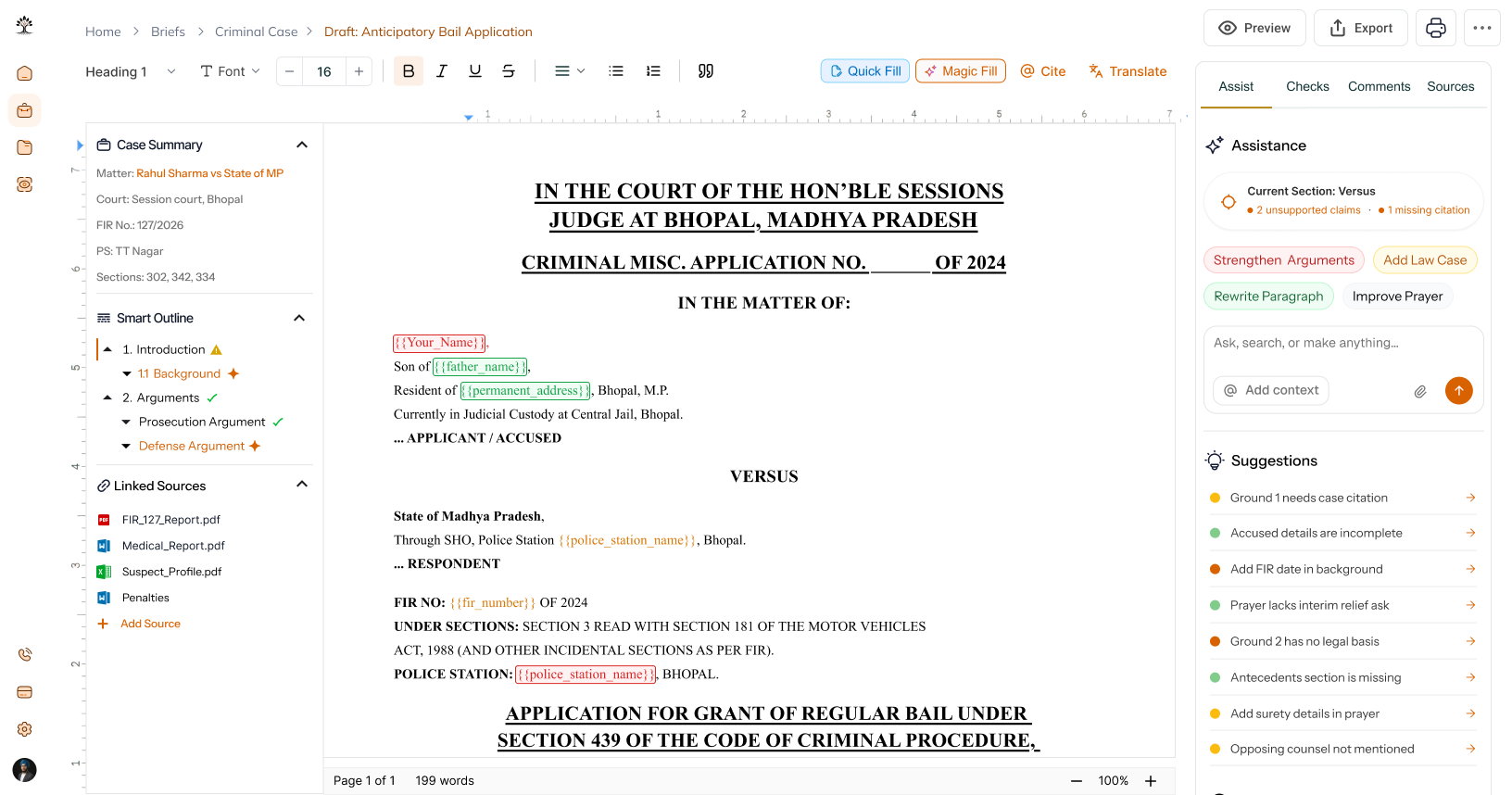
Drafting inside a matter means the case's verified facts are always within reach — and every claim can be tied back to evidence.
So the draft can use that case's verified facts — they surface as you write.
If the matter has verified facts, generation uses them automatically.
Quick Fill drops in structured facts as a lookup; Magic Fill generates narrative — always a preview you accept, never a silent overwrite.
Link any claim to its supporting source so it traces back to evidence — and appears in the Sources tab.
Outdated-law mapping (IPC → BNS), logic checks, and compliance — all in one review layer.
Generate court-ready hearing prep and argument notes from the finished draft.
Speed is a side effect; traceability is the product. Every claim traces to a source you can check — and AI-written text is always marked, never hidden.
Behind the scenes
Each capability below is a mechanism — the reason a claim about source-linked drafting is actually true.
When a draft is linked to a matter, it is built on that matter's verified facts — grounded in your case, not generic output.
Magic Fill shows source-backed and AI-unverified text differently, and unverified claims keep an [AI] marker even after you accept them.
Every Magic Fill output appears as a preview you explicitly accept, edit, or discard. The AI never changes legal text behind your back.
Link a citation and it updates the section's readiness, clears the matching "unsupported claim" finding, and appears in the Sources tab.
It flags outdated statutes with correct IPC → BNS mappings, checks internal logic, and runs compliance — a defined engine, not a guess.
If an underlying document changes after you drafted, the draft warns you — so it never quietly relies on stale evidence.
Before you ask
The draft is built on your matter's verified facts. Any AI-generated narrative is clearly marked, and unverified claims keep an [AI] tag that flows into Checks until you confirm them. You always see what is backed by a source and what isn't.
Yes. You can link any claim to its supporting document, and the Sources tab shows which document backs each section. That is the page-level trace.
Yes. Checks flags outdated statutes and gives the correct IPC → BNS mapping before you file.
Never silently. Every AI suggestion is a preview you accept, edit, or discard. You stay in control of the legal text.
Yes. From a finished draft you generate court-ready argument notes — core arguments with page and citation references, key facts, and the prayer — in one step.
Founding members
Join India's case intelligence workspace built on your own documents. 250 Founding Member spots.