

Each case keeps its own memory.
Every matter has a separate private fact database. The same document linked to two matters builds facts for each one independently — memory is scoped to one case.
Pillar 01 · Case memory for Indian advocates
The facts, parties, dates and documents that belong to a matter — remembered, verified, and never rebuilt from scratch.
Open any case and see where it stands — its verified facts, its timeline, its sources — instead of re-reading the whole file. That is what case memory means.
The question this answers
"Why can't my files just remember the case for me?"
Now they can — and they show you their sources.
What it means
A matter is a dedicated home for one case. Matter memory means that home doesn't just hold documents — it remembers who the parties are, which sections apply, the FIR number, the key dates, what each document says, and how it all connects.
This is the difference between a folder that holds files and a matter that understands the case.
When a junior leaves, when a file goes quiet for eight months, when an annexure goes missing — the case knowledge usually lives in someone's head or across scattered folders. LawVriksh moves that memory into the matter itself, where it can't fade, move, or be lost.
Every document you link becomes part of that case's own private fact memory — connected to its source, structured for review, and ready for chronology, research, drafting and hearing prep.
"A matter is one case's brain. Everything you do for that case lives inside it — and it remembers the case so you don't have to."
The real problem
A matter goes quiet for eight months. It comes back for hearing — and you re-read the whole file just to remember what it was about.
Case facts scattered across messages, a junior's notebook, an email, and three folders. Nothing is in one place.
A two-year-old matter has annexures nobody can locate, and no one remembers which FIR number or section was in play.
The junior who knew the case leaves. The knowledge leaves with them.
The common thread: the case memory lives in people's heads and scattered files — not in the matter itself. When memory is human, it fades, moves, and gets lost.
How it works
Follow the platform's own flow — the case gets a home, brings in its documents, and starts remembering them.
Add the case name, parties, court, judge, next hearing, stage and status. Now the case has a home.
Upload them to the matter, or pull them from your Personal Database vault.
The moment a document is linked, LawVriksh pulls out party names, sections, dates, FIR numbers and amounts — and writes them into that matter's fact memory.
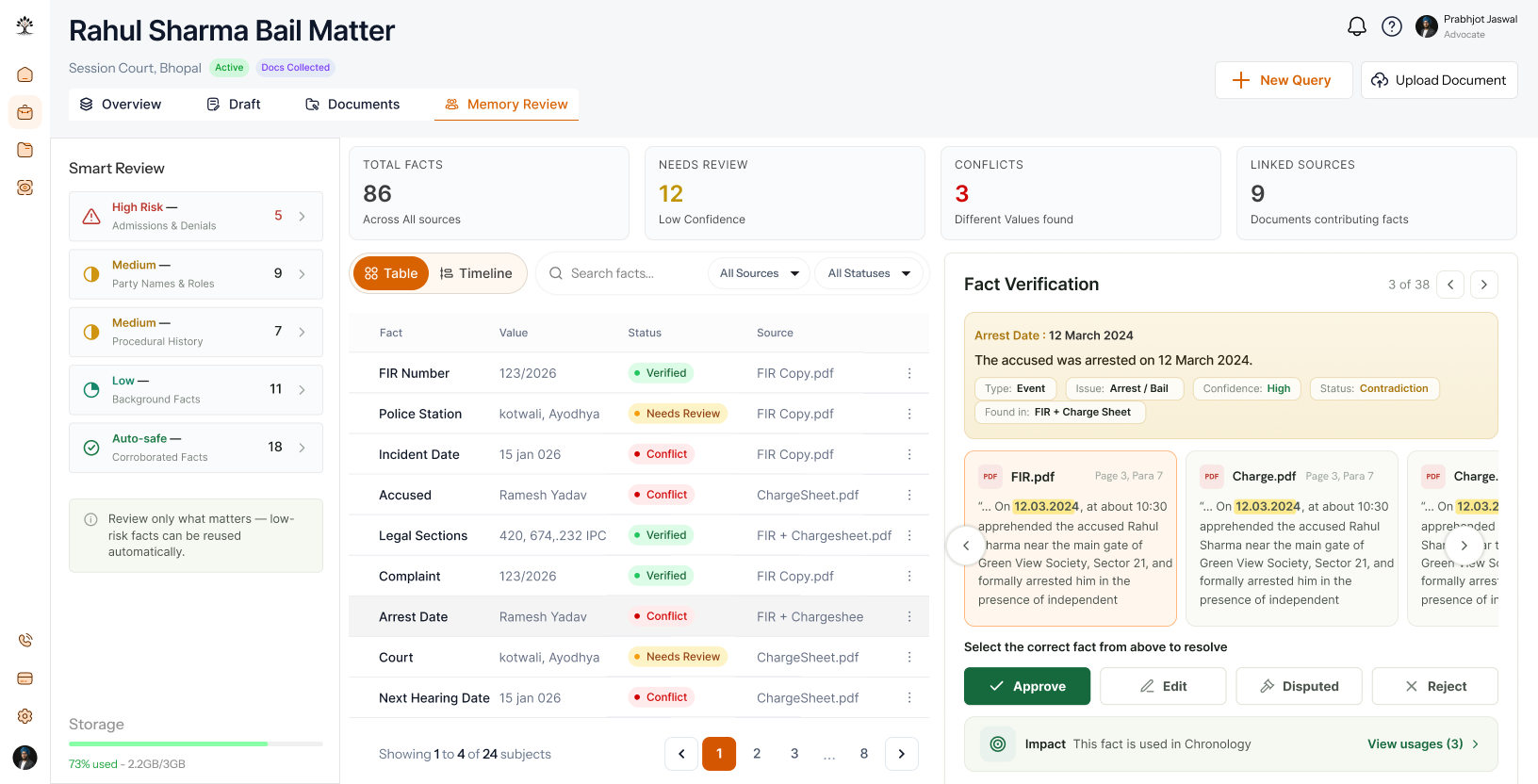
Verify facts, resolve contradictions, and see a timeline of how the case unfolds — in the Memory Review screen.
Ask the case questions, or draft on top of its verified facts. The case is now ready to work for you.
Trust comes from traceability, not a promise of perfection. LawVriksh surfaces every source and confidence band so you verify — the AI proposes, and you decide.
Behind the scenes
Each capability below is a mechanism — the reason a claim about case memory is actually true.
Every matter has a separate private fact database. The same document linked to two matters builds facts for each one independently — memory is scoped to one case.
Extraction is triggered the moment a document joins a matter. An unlinked file produces no facts and nothing is polluted across cases.
Each extracted fact stores the document and page it came from, plus a confidence band — so you can click a fact and see the exact source.
Co-occurring entities are linked — an accused in an FIR, an FIR under a section — so the matter answers relationship questions, not just keyword search.
Facts can be verified, edited, disputed or rejected, and you can add custom facts by hand. The AI proposes; the lawyer decides.
Weighted by how legally important each fact is, it tells you how trustworthy the case knowledge is before you rely on it.
Before you ask
No. The matter already holds the verified facts, parties, dates and a timeline of the case. You open the matter overview and see where it stands and what to do next — instead of re-reading the whole file.
No. Each matter has its own private fact memory. Facts are scoped to one case — nothing leaks between matters, even if the same document is used in two of them.
No. The knowledge lives in the matter, not the junior's head. The next person opens the same verified memory and continues.
Every fact shows its source document and page, plus a confidence level. You verify them in Memory Review, and a Memory Health score tells you how solid the case knowledge is before you draft.
The matter flags it as a contradiction and shows both sources side by side, so you decide which is correct. You are never silently handed a wrong fact, and high-confidence facts backed by multiple documents clear automatically.
Founding members
Join India's case intelligence workspace built on your own documents. 250 Founding Member spots.