

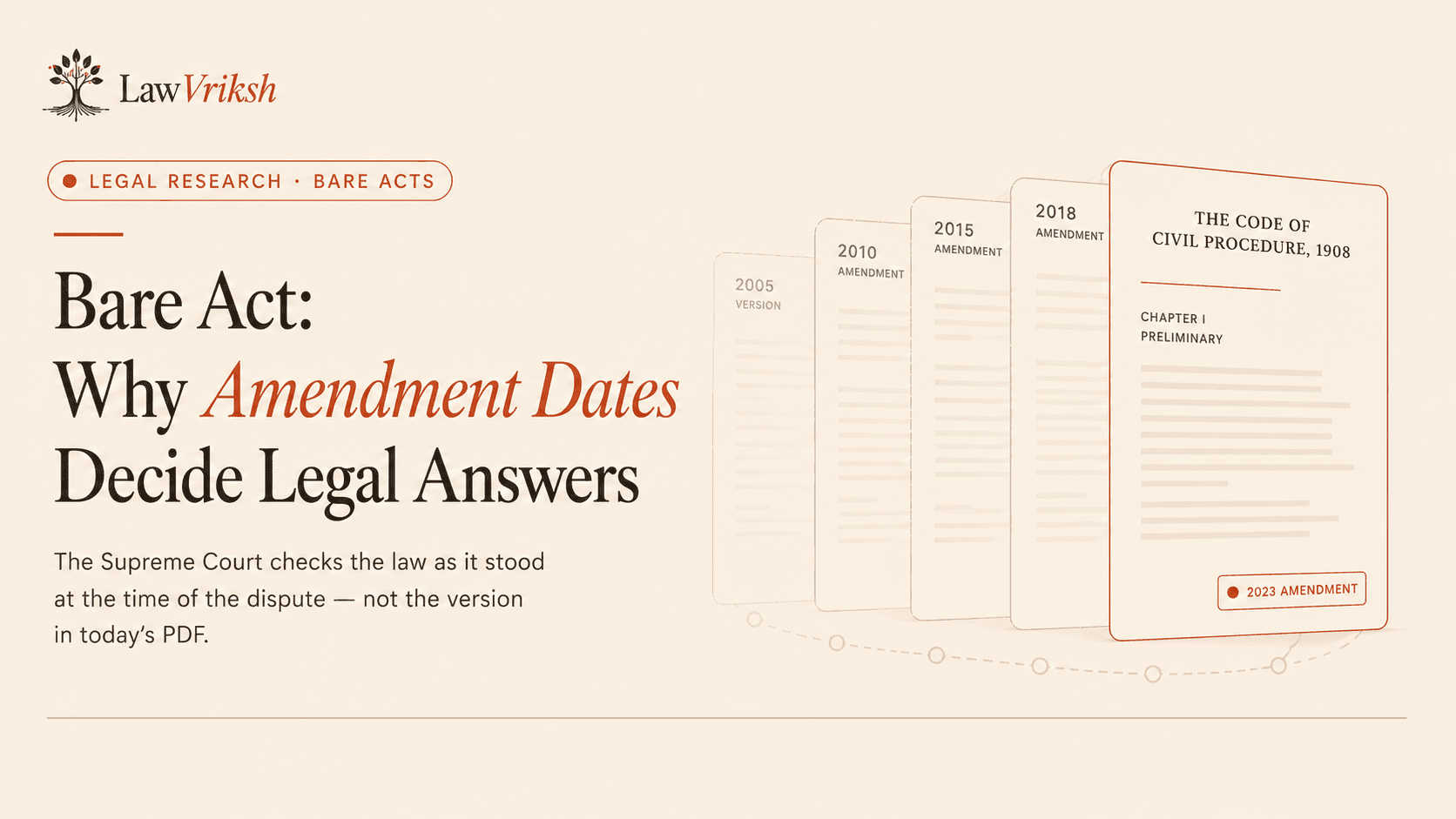
Have you ever wondered if thelaw you're citing was the one in effect during your case? In India's complex legal world, we often see a bare act as a fixed point. But, this documentchanges with new laws.
The Supreme Court often checks if the law was right at the time of the case. Finding the right version of a law is key. Using old laws can weaken your argument.
Amendment dates help figure out which laws apply to your case. Knowing these dates keeps your legal arguments strong. We must be precise to keep our cases solid.
Key Takeaways
A legal reference is not static and requires constant verification against legislative changes.
The Supreme Court relies on the specific statutory context present at the time of a dispute.
Amendment dates act as the essential filter for applying the correct law to your matter.
Using the wrong version of a statute can jeopardize your entire legal strategy.
Establishing a precise chronology of updates is vital for accurate hearing preparation.
What Is a Bare Act?
A bare act is the law as passed by Parliament, without extra comments or court views. It's key for lawyers to use in court arguments. They need the exact words of the law for their cases.
Using the law's raw text is crucial for lawyers. It helps them focus on the law's true meaning. This is the
first step in their Digitize → Understand → Map process.
The law is what the statute says, not what the commentary suggests. Always return to the source to find the truth of the provision.
Many lawyers mix up the law's original text with annotated versions. Annotated versions are useful but not as precise as the bare act. Here's why the raw text is best for your work.
Feature | Bare | Annotated |
Content | Raw Legislative Text | Text + Case Law |
Purpose | Statutory Authority | Reference & Research |
Reliability | High (Primary Source) | Variable (Secondary) |
Usage | Drafting & Arguments | Initial Case Study |
By focusing on the bare act,
lawyers keep their strategies true to the law. This approach helps them handle
complex cases with confidence. It's the best way to control your case and make
strong arguments.
Why Amendment Dates Matter in Legal Research
In a busy law office, the date of an amendment is key. You might think the latest law is always right, but
legal history shows that's not always true. Knowing how laws change is crucial for understanding rights and duties at certain times.
The Applicable Law Depends on the Relevant Date
Your legal research must focus on the date of the incident or filing. Using today's laws for past events can lead to big mistakes. The law in effect at the time of the event is what
matters.
In Allen v. Milligan, the court said some remedies are okay for a while but not forever. This shows how
important the timing of laws is. When building your case, make sure your arguments match the law as it was then.
Why the Latest Bare Act Is Not Always the Right One
It's easy to grab the newest Bare Act, thinking it's the answer. But amendment dates really show when laws are in effect. If you don't check the law's history, you might use a rule that
didn't exist or has been changed.
To keep your work accurate, follow these steps when looking at laws:
Verify the effective date of every important change
before you finish your work.
Trace the legislative history to see if a section was
active when the issue happened.
Cross-reference your findings with official updates to
make sure you're using the right law.
By focusing on version-aware
research, you help your clients avoid legal mistakes. This careful method makes
your arguments strong, defendable, and based on the law that applied at the
time.
Risks of Using the Wrong Bare Act Version
In India's legal world, the law
version you use matters a lot. Using an old bare act PDF can harm your legal
plan. If your research is based on outdated laws, your advice won't match
today's legal rules.
Incorrect Legal Research and Advice
Good legal research means
knowing the law's current status. Using an old version can lead to advice
that's not valid. This can waste time and hurt your client's trust.
For example, using the wrong
version of the Fifth or Fourteenth Amendments can be a big mistake. In domestic
law, ignoring a recent amendment makes your research outdated. Always check
your sources against the latest official updates.
Errors in Legal Documents and Court Hearings
When you draft legal documents, you must be very careful. Using a repealed section can attract unwanted attention from judges. These mistakes can be a problem during a court hearing, where judges might say the law has changed.
These errors can really hurt your case. Judges expect you to know the current law. If you don't, they might doubt your credibility.
Missing Amendments During Document Review
A thorough document review is key to avoiding legal mistakes. Missing an amendment can ruin you whole strategy. Always double-check your citations before you finalize your case files.
Risk | Outdated | Current |
Legal Strategy | High risk of rejection | Aligned with current law |
Court Hearing | Credibility loss | Professional authority |
Document Review | Prone to oversight | Verified and accurate |
Client Advice | Potentially misleading | Reliable and actionable |
Best Practices for Working with Bare Acts
Working with legal documents needs a systematic way to keep up with law changes. A disciplined method ensures your research stays accurate and reliable. This is key for a
professional legal practice.
Verify Amendment Dates Before Research
Before diving into analysis, check the law's current status. Confirming amendment dates is crucial. It stops you from using outdated or changed laws.
Make a checklist for each new case. Note the latest amendment date. This creates a clear audit trail for your research. It keeps your arguments strong against outdated laws.
Cross-Check Bare Act PDFs and Notifications
Don't assume a bare act PDF is always up-to-date. Always check it against official government gazette
notifications.
If there's a difference, trust the official notification more. Having verified, source-linked documents keeps your work solid and defendable in court.
Keep Legal Documents Version-Aware
It's important to know which version of the bare act you're using. Clearly state the version in your
pleadings or opinions.
This makes it easy for your team to understand the case's legal context. It also makes updating your work simpler if new amendments come up during the case.
Verification | Primary | Frequency |
Manual Date Check | Ensures amendment dates are current | Every research session |
Gazette Cross-Reference | Validates the bare act PDF accuracy | Before final filing |
Version Tracking | Maintains document integrity | During drafting phase |
How Legal AI Improves Bare Act Research
Legal AI is a game-changer for lawyers dealing with lots of document review. It helps you work faster and more accurately with complex laws.
Identify the Applicable Statutory Version
Finding the right law version for a case can take a long time. Legal technology makes this quick, saving
hours. This ensures your research is up-to-date.
Reduce Manual Document Review
Manual document review can be tiring and might miss important changes. Legal AI automates this process. This lets your team focus on strategy, not just checking details.
Improve Litigation Management with Verified Legal Context
Good litigation management means solid, defendable arguments. These tools keep your legal documents current. This way, your case files are always in order, improving your legal technology.
Using these systems makes your work more reliable. It doesn't replace your judgment; it boosts your ability to give good legal advice.
How LawVriksh Makes Version-Aware Legal Research Easier
Managing complex legal files needs a system that values your chamber workflow precision. We think technology should be a reliable helper, giving you the structure you need. It should never
replace your professional judgment. Our platform offers a complete solution to
keep your research based on verified, source-linked evidence.
Digitize → Understand → Map Facts → Draft
Our framework follows the natural flow of a lawyer's work. You start by digitizing your case files. This
lets the system understand the context of your documents.
Once the data is in, you can link specific facts to relevant laws. This ensures your drafts are not just
well-written but also legally correct. By keeping a clear link between casefacts and laws, you build a source-linked foundation for every case.
Searchable Matter Memory
Finding the right information in a lot of paperwork is hard. Our searchable matter memory indexes and links every piece of research to its source. This gives you a reliable page-level trace for your files, so you always know where an argument comes from.
Cite-as-you-write, AI Markers, and the Checks Panel
Our tools keep control in your hands. The Cite-as-you-write feature lets you insert references accurately. We also use AI markers to highlight unverified content, so you know what needs
your review.
Our Checks Panel also helps by flagging outdated references. It alerts you to changes, like the Indian Penal Code (IPC) to Bharatiya Nyaya Sanhita (BNS) mapping. This lets you update your
arguments before court.
Feature | Manual | LawVriksh |
Source Traceability | Memory-dependent | Page-level trace |
Amendment Tracking | Manual verification | Automated alerts |
Document Mapping | Fragmented | Integrated workflow |
Verification | High risk of error | Checks Panel support |
Frequently Asked Questions
We answer common questions about using bare acts and modern research tools. These answers help make your work flow better and keep standards high.
What Is a Bare Act?
A bare act is the original version of a law passed by the government. It doesn't include any extra notes
or case studies. Lawyers use these acts to make sure their arguments are based on the law's exact words.
Why Do Amendment Dates Matter?
The law changes over time with new updates. Using the wrong version can cause big mistakes in court. For example, the Fifth Amendment was added in 1791, showing how laws can last a
long time.
Even small changes in wording can change how a law is understood. So, knowing the exact date of a change is very important.
How Does Legal AI Help with Legal Research?
Legal AI makes your research faster and more accurate. It finds the right versions of laws for you, saving time. This lets you focus on the big picture, not just checking details.
How Does LawVriksh Prevent Reliance on Outdated Laws?
LawVriksh makes sure you use them right laws at the right time. It keeps track of changes so you don't use law that are no longer valid. This way, you can be sure your research is always upto date.
Feature | Traditional | AI-Assisted |
Version Tracking | Manual and error-prone | Automated and verified |
Amendment Checks | Time-consuming | Instant alerts |
Document Accuracy | Risk of outdated citations | High reliability |
Workflow Speed | Slow | Optimized |
Build Court-Ready Research with the Right Version of the Law
Effective litigation management is about precision, not just having the latest legal texts. You need to find
the exact statute version for your case. This makes sure your arguments are strong.
Using a version-aware research strategy keeps your work solid. It makes sure you're ready for court without any doubts. Your citations will match the law at the time, giving you
confidence.
With LawVriksh, you combine your legal skills with technical precision. This leads to better results for your clients. Trust a system that values accuracy and amendment dates as much as you do.