

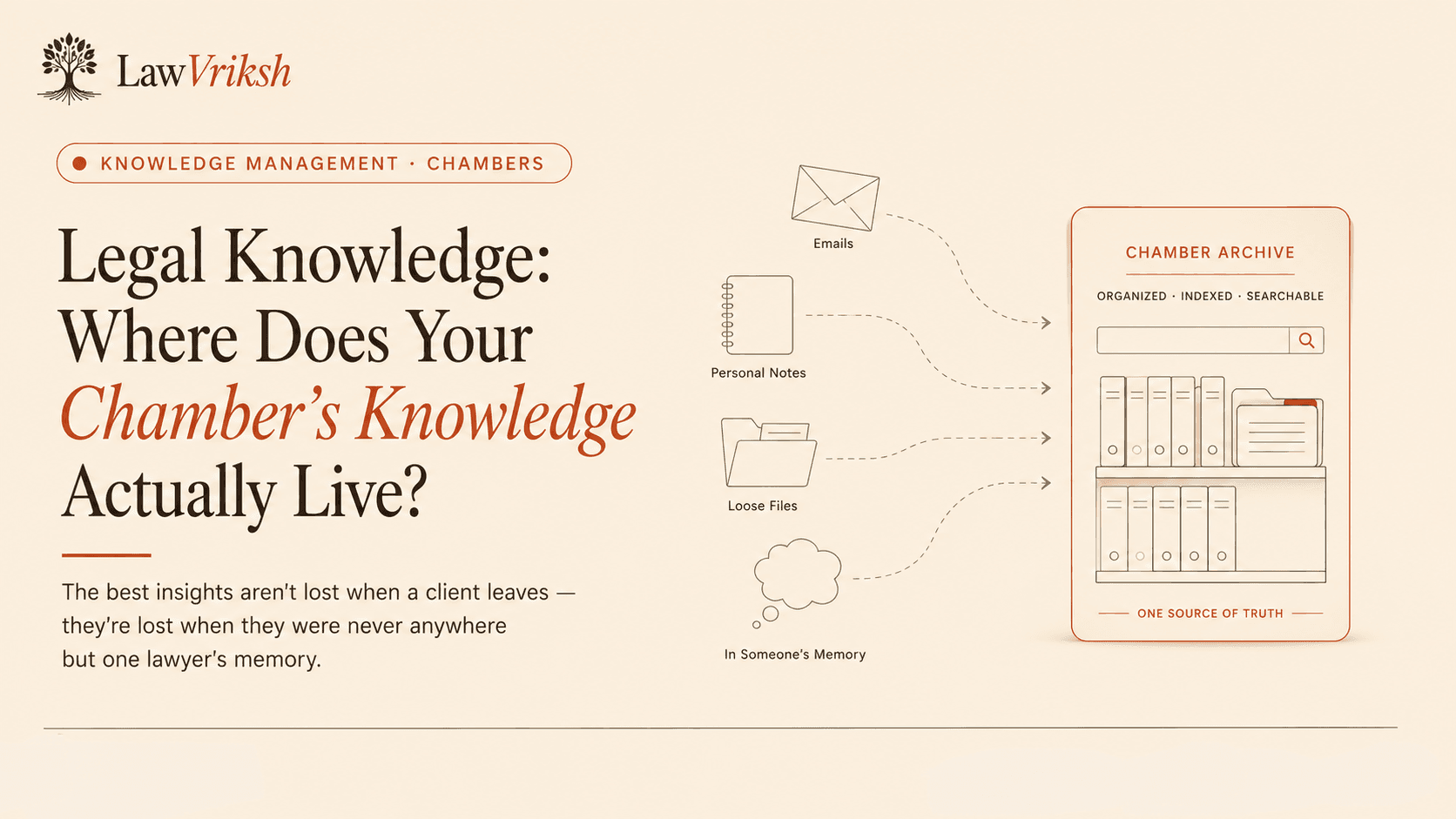
Ever thought about where your team's knowledge goes when a key person is away? Often, the best insights are hidden in emails, files, or team memories.
We work hard to make sure our LinkedIn profiles are seen and respected. But we often forget about the
internal assets that help us succeed every day. Your firm's legal knowledge is crucial, needing the same care as your online image.
It's not just about storing info; it's about making it easy to find and use. By treating your case data as
a strategic resource, you change how your team gets ready for court. A well-organized system keeps your knowledge ready for new cases.
Key Takeaways
See your internal info as a key business asset, not just papers.
Use the same effort for your internal systems as for your LinkedIn profile.
Focus on organizing case data for long-term memory.
Make important facts easy for your team to find, improving court prep.
Keep control over your digital files for accuracy and trust.
What Is Legal Knowledge?
Your chamber's true value comes from the legal knowledge it gains over years. This is the sum of all the
intelligence, procedural history, and insights from cases. It's the living record of how your team handles complex cases.
In many chambers, this important info is stuck in personal notes, emails, and memories. When key insights are only in one lawyer's folders or emails, they're hard for others to find. This systemic bottleneck stops your firm from building a strong shared memory.
Seeing this problem is the first step to a better way. By organizing data well, you make legal knowledge a shared asset, not a secret. We think that when you manage these insights well, you help every lawyer do their best work.
Why Legal Knowledge Management Matters for Chambers of Law
Effective legal knowledge management is key for any top chamber of law. Without a central system, your team's success is at risk. It's not right to rely only on senior advocates or scattered files for knowledge.
In many chambers of law, important case details get lost. This happens when a junior associate leaves a file goes missing. Your team then has to redo research, wasting time and resources.
Another big problem is inconsistent case preparation. Without a shared method, team members might see things differently. This can lead to weaknesses that the other side can use against you. Also, bringing in new talent is hard without a clear system. New associates find it hard to learn from past cases, slowing down the team.
The table below shows how different a systematic approach is from just doing things as they come.
Feature | Ad-hoc | Systematic |
Research Efficiency | High duplication of effort | Reusable, searchable insights |
Onboarding Speed | Slow and mentor-dependent | Fast with accessible archives |
Case Consistency | Prone to human error | Standardized and verified |
Knowledge Retention | Lost when staff leaves | Preserved within the chamber |
By focusing on legal knowledge
management, your chamber gets stronger. You avoid the dangers of scattered
information and create a precise culture. This lets your team concentrate on
strategy, not just getting things done.
Where Legal Knowledge Gets Lost
Information can quietly disappear when it's not organized. Without a plan for legal knowledge
management, your team's skills can fade away. When info is scattered, it's easy to lose it.
Knowledge Locked in Individual Lawyers
Many teams rely too much on one person's memory. When key details are stored in someone's head, it's hard for others to access. This makes it tough when that person leaves.
When someone leaves, important details can be lost. Effective knowledge retention means using a system everyone can use, not just one person's memory.
The greatest danger to a firm is not the loss of a client, but the loss of the institutional wisdom that
keeps the firm running.
Scattered Case Files and Legal Documents
Case files and legal documents are often scattered. They might be in filing cabinets, on computers, or in
emails. This makes it hard to find what you need quickly.
Looking for documents takes away from time spent on actual legal work. Without a central place for files, it's hard to link facts from different cases. Centralization helps your team find what they need fast.
Repeating Legal Research Across Matters
Duplicating effort is a big problem in law. Advocates often redo the same legal research because they can't find past work. This wastes time and money.
Not using past research means your team has to start over. Standardizing your workflow helps make sure
research is used again, saving time and effort.
Building a Shared Legal Knowledge System
Your chamber's collective intelligence is its most valuable asset. Yet, it often remains trapped in
fragmented files. When information exists only in the minds of individual lawyers or isolated folders, your team loses the ability to act as a unified front. We advocate for a shift toward centralized litigation management that turns your experience into a durable, shared resource.
Organize Case Files Around the Matter
Modern legal technology allows you to move away from chaotic, desktop-based storage. By organizing all case files around the specific matter, you ensure that every document, note, and filing is linked to its context. This structure prevents the common issue of searching through endless email threads or local drives to find a single relevant document.
Preserve Verified Facts and Procedural History
Traceability is the cornerstone of a strong legal practice. You must ensure that verified facts and the
procedural history of a case remain accessible to the entire team throughout the life of the matter. When you document these elements within a shared system, you eliminate the risk of losing critical insights during staff transitions or long-term litigation.
Make Legal Knowledge Searchable and Reusable
A truly effective system does more than store data; it makes that data searchable and reusable. By standardizing how you capture information, you create a library of precedents and strategies that benefit future cases. This approach transforms your chamber's history into a powerful tool for efficiency and accuracy.
Feature | Traditional | Shared |
Accessibility | Individual silos | Team-wide access |
Traceability | Manual and prone to error | Automated and verified |
Efficiency | High duplicate work | Reusable assets |
Searchability | Limited to file names | Full-text and context-aware |
How Legal AI Improves Legal Knowledge Management
Legal AI boosts chambers of law
by organizing information. It moves away from manual filing, making your
practice more efficient. This change lets your team focus on important legal
work, not just finding documents.
Connect Legal Research to Case Context
Good legal knowledge management
is more than just storing documents. It's about linking them to real case
facts. Legal technology helps connect your research to the case history. This
makes sure your references are always relevant and solid.
Reduce Duplicate Work Across Matters
Repeating research is a big
time-waster. AI tools find relevant precedents and arguments from past cases.
This creates a living library of your firm's work. So, you don't have to start
over when a similar case comes up.
Improve Collaboration Across the Chamber
Centralizing legal knowledge
helps everyone in the chamber. It creates a culture of quality and consistency.
This way, the knowledge of senior advocates is shared and used by all.
Feature | Traditional | AI-Enhanced |
Research Retrieval | Manual search in folders | Instant cross-matter search |
Knowledge Sharing | Verbal or email updates | Centralized matter memory |
Duplicate Effort | High risk of repetition | Minimized through surfacing |
Data Accuracy | Dependent on memory | Verified source-linked facts |
How LawVriksh Preserves Legal Knowledge
Keeping your chamber's memory
alive starts with digitizing and mapping case facts. LawVriksh is designed to
keep your legal knowledge accessible, accurate, and in your control. This is
true for the whole time a case is active.
Digitize → Understand → Map Facts → Draft
Our platform offers a structured
workflow. It lets you digitize, understand, map facts, and draft with
precision. This way, you move from scattered storage to a unified story for
each case.
This method helps your team go
from raw case files to a strong argument. Every step supports the advocate's
judgment, not replacing it.
Searchable Matter Memory
LawVriksh creates a searchable
matter memory. It makes sure every document is linked and easy to find. You
don't have to search through physical folders or digital drives anymore.
With a centralized repository,
your legal documents stay organized. They're linked to the facts they support.
This is key for keeping standards high during complex hearings.
Cite-as-you-write, AI Markers, and the Checks Panel
We help you keep accuracy high
with special tools. Cite-as-you-write lets you link evidence to drafts in
real-time.
Our AI markers and Checks Panel
are the last check on your work. They help spot gaps in your arguments before
court.
Feature | Traditional | LawVriksh |
Document Retrieval | Manual search in folders | Instant searchable memory |
Fact Mapping | Mental or handwritten notes | Digital, linked fact-mapping |
Drafting Accuracy | Manual cross-referencing | Automated cite-as-you-write |
Knowledge Retention | Lost when lawyers leave | Preserved in chamber system |
Frequently Asked Questions
Effective litigation management
starts with knowing how your chamber keeps and finds information. We've
answered the most common questions from advocates about keeping institutional
memory.
What is legal knowledge management?
Legal knowledge management is
about organizing your chamber's expertise. It makes sure all documents and
facts are easy to find for your team, even after cases are closed.
Why is legal knowledge important for litigation?
In big cases, traceability is
key. Keeping a clear record of your legal knowledge helps avoid redoing
research. It also makes sure your arguments are solid and saves time when
preparing for hearings.
How does legal AI improve legal knowledge management?
Modern legal AI boosts your
work. It connects facts to case documents and finds hidden links. This makes
your digital files more than just stored; they're ready to use.
How does LawVriksh help preserve legal knowledge?
LawVriksh offers a place to
digitize, map, and draft with control. Our platform makes a searchable matter
memory. It lets you link every citation to its source. This keeps you in charge
and ensures no important info is lost.
Build a Searchable Legal Knowledge System with LawVriksh
Your chamber's legal knowledge
is too valuable to stay in one person's head or scattered files. Relying on a
few lawyers' memories is not strong enough for your practice.
A shared, searchable system
changes how your team deals with complex cases. It keeps all legal knowledge in
one place. This makes sure every lawyer is ready, efficient, and consistent. It
also protects your firm from losing important knowledge when lawyers leave.
We invite you to work with
LawVriksh to create a strong base for your work. Our platform helps you turn
your knowledge into a digital, lasting record. Start making your practice more
organized by using these tools every day.
Secure your firm's future by
keeping your collective knowledge safe. Contact our team to learn how LawVriksh
meets your litigation needs.