

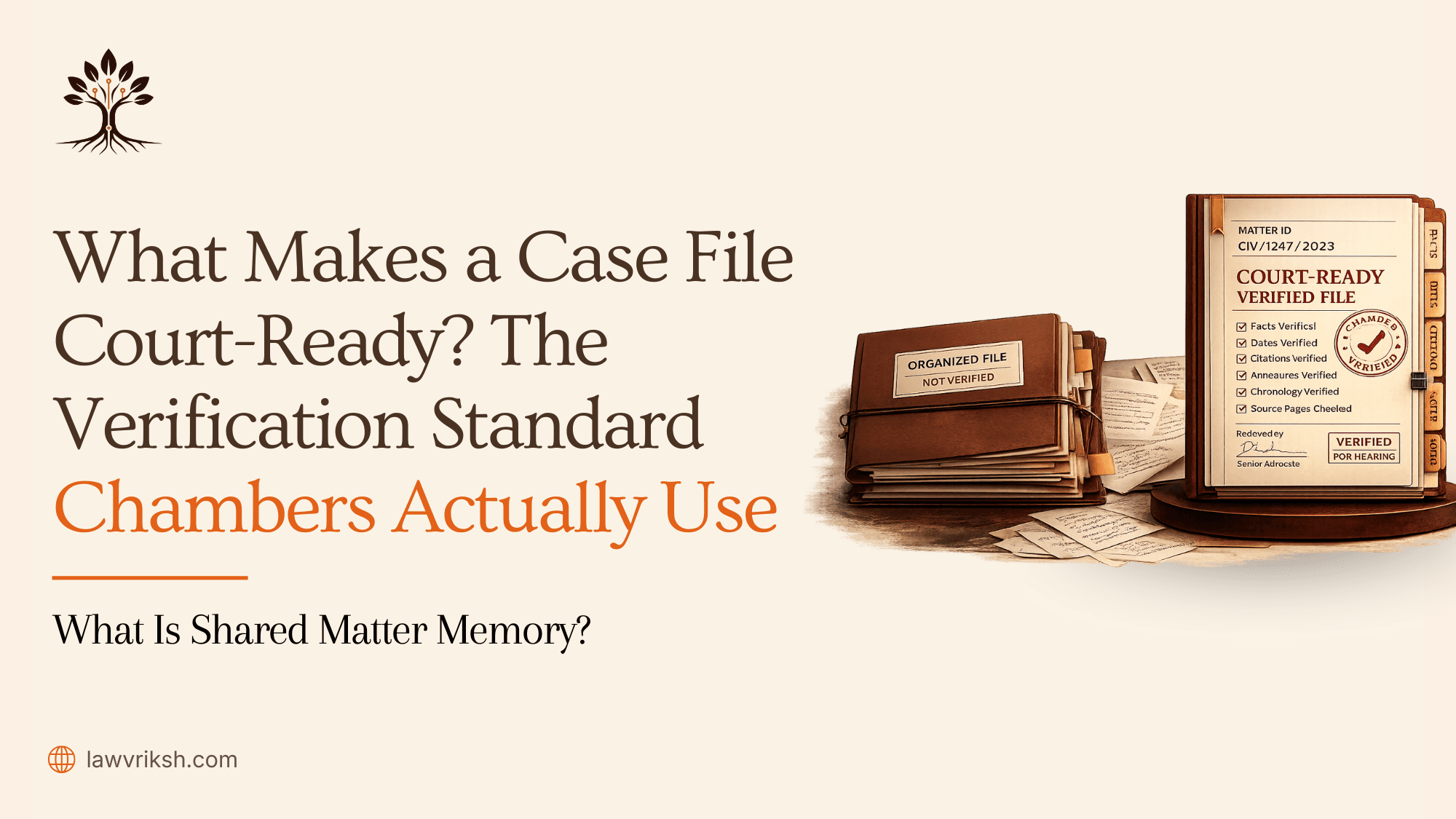
Top litigation chambers know court readiness is
more than document organization. Every important fact, citation, date, and
annexure must be verified before the file can be trusted in court.
A court hearing preparation checklist is more
than a task list. It is a verification standard that turns documents into a
reliable case, ensuring every claim is supported before the hearing begins.
Key Takeaways
Senior advocates perform final
verification to ensure complete accuracy.
Court readiness depends on
source-linked verification, not document storage.
A structured workflow turns
documents into reliable courtroom preparation.
Consistent verification builds
trust and improves litigation outcomes.
Modern workflows should preserve
advocate control and verified matter memory.
The Myth of the Organized
File vs. The Reality of the Trusted File
Many chambers assume that once documents are
stored digitally, the file is ready for court. But a folder full of PDFs—even
if well organized—is not a court-ready file.
Court readiness begins with a different
question: Can this file be trusted?
A file becomes court-ready only when every
important fact, date, citation, and annexure has been verified. Digital storage
preserves documents. Verification creates confidence.
"Evidence is not just a
document; it's the truth of the facts in that document, proven against the
record."
The difference is clear:
Built for document retrieval | Built for fact verification |
Stores raw, unlinked PDFs | Maps verified facts to their sources |
Keeps documents available | Keeps evidence trustworthy |
Makes lawyers search | Gives lawyers confidence |
A court-ready file is not defined by the amount
of information it contains, but by how much of that information has been
verified. The shift is from storing documents to understanding and trusting the
case before entering the courtroom.
Why Senior Advocates Recheck
Every Document Before a Hearing
Professional diligence requires every document
to be verified before it reaches the court. Junior advocates prepare the file,
but the senior advocate carries the final responsibility. That is why court
hearing preparation for advocates always includes a final review.
Rechecking facts, citations, dates, and
annexures is not about doubting the team. It is about ensuring every argument
is supported by verified evidence before stepping into court.
Even a small error can weaken a case. Final
verification gives the advocate confidence to answer questions from the bench
without hesitation.
Initial Drafting | Content creation | Draft readiness |
Junior Review | Formatting, completeness | Standard compliance |
Senior Verification | Court hearing preparation for advocates | Case integrity |
Final Hearing | Oral arguments | Confident advocacy |
This final review is not an extra step. It is
the process that turns an organized file into a court-ready one. Much of this
verification happens because older matters become difficult to recall before
a hearing.
Defining the Court Hearing
Preparation Checklist as a Verification Standard
A court hearing preparation checklist is
more than a list of tasks. It is a verification standard that ensures every
fact, document, and procedural requirement is reviewed before the matter
reaches court.
This approach shifts preparation from completing
tasks to confirming accuracy. A structured hearing preparation checklist for
lawyers helps identify missing evidence, inconsistent facts, and procedural
gaps before they affect the hearing.
When every member of the chamber follows the
same verification process, quality becomes consistent rather than dependent on
individual habits.
Focuses on task completion | Focuses on procedural integrity |
Prioritizes speed | Prioritizes accuracy and traceability |
Creates subjective readiness | Creates court-ready confidence |
Varies by individual | Follows a chamber-wide standard |
Adopting a standard operating procedure means your files are not only organized but
consistently verified before court. That consistency strengthens both
professional confidence and chamber reliability.
The Anatomy of a Verified
Case File
A court-ready file is built through
verification, not document storage. Every claim should be supported by evidence
that can be traced back to its source, giving the advocate confidence before
the hearing.
Fact-Checking and
Citation Integrity
Every document should be verified before it
becomes part of the case. Each pleading must connect to the correct source
page, creating a reliable chain of evidence.
Citation integrity is more than organization. It
allows the advocate to demonstrate exactly where every fact originates,
reducing errors and strengthening credibility in court.
Chronology
Mapping and Narrative Consistency
A clear case chronology for hearing
preparation keeps facts, evidence, and arguments aligned. Without a
verified timeline, even strong evidence can lose its impact.
Mapping events chronologically helps identify
inconsistencies early and ensures every document supports a consistent legal
narrative throughout the hearing.
Annexure
Authentication and Cross-Referencing
Effective legal document verification
includes authenticating every annexure and making it easy to trace each
document during arguments.
Cross-referencing annexures with pleadings and
evidence strengthens the case, reduces delays in locating documents, and
ensures every argument is supported by verified records.
How Junior Advocates Can
Master the Chamber Workflow
An effective litigation chamber workflow in
India depends on junior advocates building a reliable foundation before the
file reaches the senior. Their role is not just to organize documents but to
ensure the file is complete, verified, and ready for review.
A structured workflow reduces errors, improves
consistency, and allows the senior advocate to focus on legal strategy instead
of rechecking basic information.
The Handover
Protocol from Junior to Senior
A consistent junior-to-senior file handover
ensures every file is reviewed before submission.
Verify the index: Ensure every annexure matches both the physical and digital file.
Check citations: Confirm case laws are current and support the arguments.
Review chronology: Match dates in pleadings with supporting evidence.
Flag missing documents: Identify gaps requiring immediate follow-up.
Identifying Red
Flags in Pleadings and Evidence
Junior advocates should identify issues before
the hearing, including:
Inconsistent dates: Differences between affidavits and supporting records.
Unauthenticated annexures: Documents that cannot be verified.
Contradictory statements: Inconsistencies across pleadings.
Missing signatures: Unsigned documents that may delay proceedings.
Consistently following this workflow improves
the quality of every handover, helping senior advocates review a verified file
instead of rebuilding one.
Bridging the Gap Between
Digital Storage and Court Readiness
A digital archive is only as valuable as your
ability to verify its contents before a hearing. While many chambers have
replaced paper files with digital storage, storing documents alone does not
make a file court-ready.
True preparation comes from connecting evidence
to the legal narrative. Digital tools should support verification, not function
only as filing cabinets.
Why Standard Case
Management Software Often Falls Short
Most law firm case management software in
India is designed for administrative tasks such as document storage, client
management, and deadline tracking. While these functions improve organization,
they often treat documents as static files rather than verified evidence.
A lawyer may quickly retrieve a document but
still spend valuable time confirming whether it supports the chronology,
pleadings, or arguments. The challenge is no longer finding the file—it is
trusting the information inside it.
Moving Beyond
Document Retrieval to Contextual Verification
Effective legal document verification
requires more than document retrieval. It requires connecting facts, dates,
pleadings, and annexures so every claim can be traced to its source.
A verification-first workflow transforms a
digital archive into a reliable litigation resource. Technology should
strengthen legal judgment, not replace it, allowing advocates to maintain
control while preparing files that are genuinely court-ready.
Institutional Standards and
Lawyer Accountability
Every document filed reflects a lawyer's
professional standards. A strong litigation workflow is not only about
efficiency but also about meeting the court's expectation of accuracy and
accountability.
Lessons from
Supreme Court and High Court Practice Directions
Supreme Court and
High Court practice directions reinforce that an advocate's duty extends beyond
representation. Lawyers are expected to verify facts, apply the law correctly,
and assist the court with accurate submissions.
"The duty of an advocate is to
assist the court in the administration of justice, ensuring that every
submission is grounded in verified fact and sound legal principle."
Embedding these standards into your chamber
workflow reduces avoidable errors, protects professional credibility, and
strengthens the court's confidence in your submissions.
The Role of
Professional Diligence in Litigation Success
Professional diligence is demonstrated through:
Verification of facts: Every claim should be supported by evidence.
Procedural compliance: Follow applicable court rules and
procedures.
Accountability: Take responsibility for the accuracy of every document, citation, and
submission.
Consistent verification strengthens both
litigation outcomes and professional reputation.
Conclusion
A file becomes court-ready not when documents
are stored, but when every important fact has been verified.
A structured court hearing preparation
checklist, clear handover process, and consistent verification standard
help chambers build reliable files instead of repeatedly rebuilding trust
before every hearing.
Verification is more than a final review. It is
the foundation of professional confidence, stronger advocacy, and dependable
courtroom preparation.
FAQ
What makes a file
court-ready?
A file is court-ready when every important fact,
date, citation, and annexure has been verified and linked to supporting
evidence—not simply organized or digitized.
What is the
difference between an organized file and a trusted file?
An organized file stores documents. A trusted
file verifies facts, connects evidence to its source, and gives advocates
confidence during hearings.
Why should a
hearing preparation checklist focus on verification?
Verification ensures facts, chronology, and
evidence are consistent before court, reducing last-minute corrections and
improving hearing preparation.
How can
litigation chambers create a verification standard?
By adopting a consistent review process with
defined handover standards, page-level verification, and clear accountability
across the chamber.
What should be
verified before court?
Verify citations, annexures, chronology,
pleadings, and supporting evidence to ensure every submission is accurate and
traceable.
Why doesn't
traditional case management software fully solve this problem?
Most systems organize documents and deadlines
but do not verify legal context, chronology, or evidentiary support.
Why is chronology
important?
A verified chronology links every event to
supporting evidence, helping advocates present a consistent legal narrative.
What is the
junior advocate's role?
Junior advocates prepare a verified file by
checking documents, identifying gaps, and following a structured handover
before senior review.